The Rise of Condottieri: The Mercenary System in 14th-Century Italy
The Rise of Condottieri: The Mercenary System in 14th-Century Italy
Overview In the fourteenth and fifteenth centuries, the Italian city-states of Tuscany, including Florence, Pisa, and Siena, were frequently at war with each other or with neighboring towns. To wage these wars, they employed condottieri, military contractors who raised armies to fight on behalf of their clients in exchange for payment. Among these condottieri was Sir John Hawkwood, an Englishman known as Giovanni Acuto (John the Acute), who became a renowned figure in Italian warfare.
Context During the 14th century, Italy was characterized by a complex system of city-states, each with its own government and military forces. The city-state system, where independent cities governed themselves and often clashed over territory and resources, created an environment conducive to mercenary warfare. The Black Death, which ravaged Europe in the mid-14th century, had also led to significant social and economic upheaval, contributing to a growing demand for military services.
Timeline
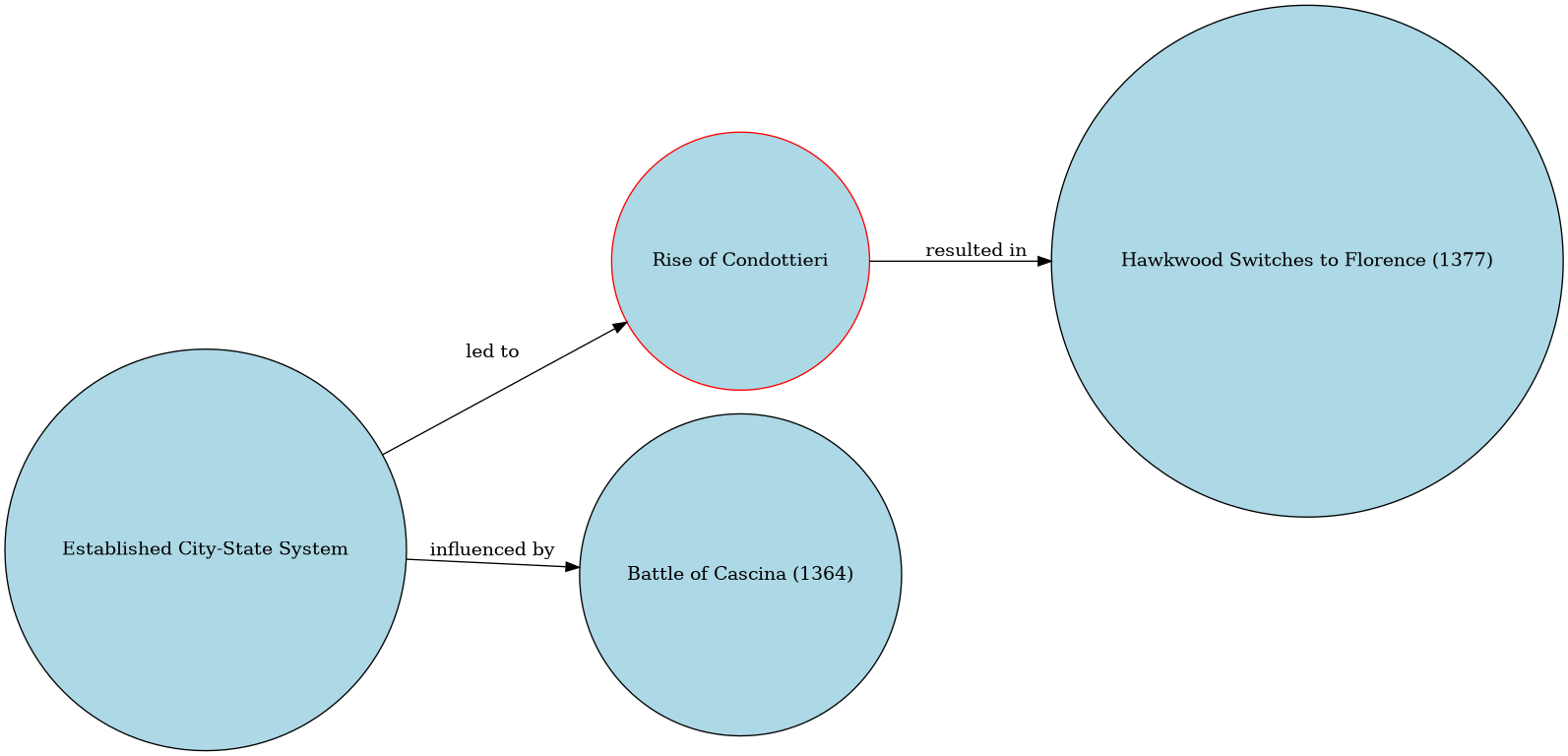
- 1320s: The city-state system is established in Tuscany, with Florence, Pisa, and Siena emerging as major powers.
- 1360s: Condottieri begin to play a significant role in Italian warfare, with Sir John Hawkwood rising to prominence.
- 1364: Hawkwood fights for Pisa against Florence in the Battle of Cascina.
- 1370s: Hawkwood switches allegiance to serve Florence, becoming a key figure in the city’s military campaigns.
- 1381: Hawkwood is commissioned by the Florentine government to lead a military expedition against Milan.
Key Terms and Concepts
- Condottieri: Military contractors who raised armies to fight on behalf of their clients in exchange for payment.
- City-state system: A system where independent cities governed themselves and often clashed over territory and resources.
- Mercenary warfare: Warfare waged by soldiers hired for personal gain, rather than national loyalty or ideological commitment.
- Giovanni Acuto (John the Acute): The nickname given to Sir John Hawkwood due to his exceptional military prowess.
Key Figures and Groups
- Sir John Hawkwood (Giovanni Acuto): An English mercenary who became a renowned figure in Italian warfare, serving various city-states including Florence and Pisa.
- Florentine government: The ruling body of the city-state of Florence, which employed Hawkwood as a condottiero to fight on their behalf.
Mechanisms and Processes
Hawkwood’s employment by various city-states can be seen as follows:
- Hawkwood fights for Pisa against Florence (1364) →
- Hawkwood switches allegiance to serve Florence (1370s) →
- Hawkwood becomes a key figure in the Florentine military campaigns, leading expeditions against Milan (1381)
Deep Background The rise of condottieri in 14th-century Italy was influenced by several long-term trends:
- The decline of feudalism: As feudal relationships weakened, lords and vassals began to seek alternative ways to employ their military forces.
- The growth of trade: Increased commerce led to the development of mercantile cities like Florence, which required skilled military forces to protect their interests.
- The impact of the Black Death: The devastating pandemic had disrupted traditional social and economic structures, creating opportunities for mercenaries to fill the power vacuum.
Explanation and Importance Hawkwood’s career illustrates the complexities of mercenary warfare in 14th-century Italy. His ability to switch allegiance between city-states highlights the fluid nature of alliances and the importance of personal gain in this system. Hawkwood’s success also underscores the critical role played by condottieri in shaping the course of Italian conflicts.
Comparative Insight The rise of condottieri in Italy can be compared to similar developments in other regions, such as:
- The Hanseatic League: A confederation of merchant cities that employed mercenaries in the Baltic region during the 14th century.
- The Ottoman Empire: Which also relied heavily on mercenary forces to expand its territories.
Extended Analysis
Theme 1: The Economics of Mercenary Warfare The employment of condottieri was driven by economic considerations, with city-states seeking to minimize their military expenses. This led to the development of a system where mercenaries fought for whoever paid them most, rather than adhering to traditional feudal obligations.
Theme 2: The Personalization of War Hawkwood’s career highlights the growing importance of individual personalities in shaping the course of warfare. As city-states began to rely more heavily on mercenary forces, commanders like Hawkwood became key figures in determining the outcome of battles.
Theme 3: The Impact on Italian Society The rise of condottieri and the mercenary system had significant social implications for Italy. The increasing reliance on mercenaries contributed to a growing divide between the wealthy elite and the poor, as well as the erosion of traditional feudal relationships.
Open Thinking Questions
- How did the city-state system in 14th-century Italy create an environment conducive to mercenary warfare?
- What role did personal gain play in shaping Hawkwood’s career and decisions?
- In what ways did the rise of condottieri influence the course of Italian conflicts, and what were the long-term consequences for society?
Conclusion The life and career of Sir John Hawkwood illustrate the complexities of mercenary warfare in 14th-century Italy. As a renowned condottiero, he exemplified the growing importance of individual personalities in shaping the course of warfare, while also highlighting the critical role played by economic considerations in driving the development of this system.