Bayesian Probability: A Foundational Concept

Bayesian Probability: A Foundational Concept
Overview In the mid-18th century, Thomas Bayes, a British mathematician and Presbyterian minister, developed a groundbreaking concept known as Bayesian probability. This innovative approach to probability theory laid the foundation for modern statistical inference and decision-making under uncertainty. Bayesian probability is a method of updating probabilities based on new evidence or data, allowing for more accurate predictions and informed decisions.
Context During this period, the Enlightenment was in full swing, with thinkers like Bayes, Isaac Newton, and Gottfried Wilhelm Leibniz contributing to major advances in mathematics, science, and philosophy. The Scientific Revolution, which began in the 16th century, continued to shape the intellectual landscape of Europe. As scientific discoveries proliferated, the need for more sophisticated mathematical tools became increasingly apparent.
Timeline
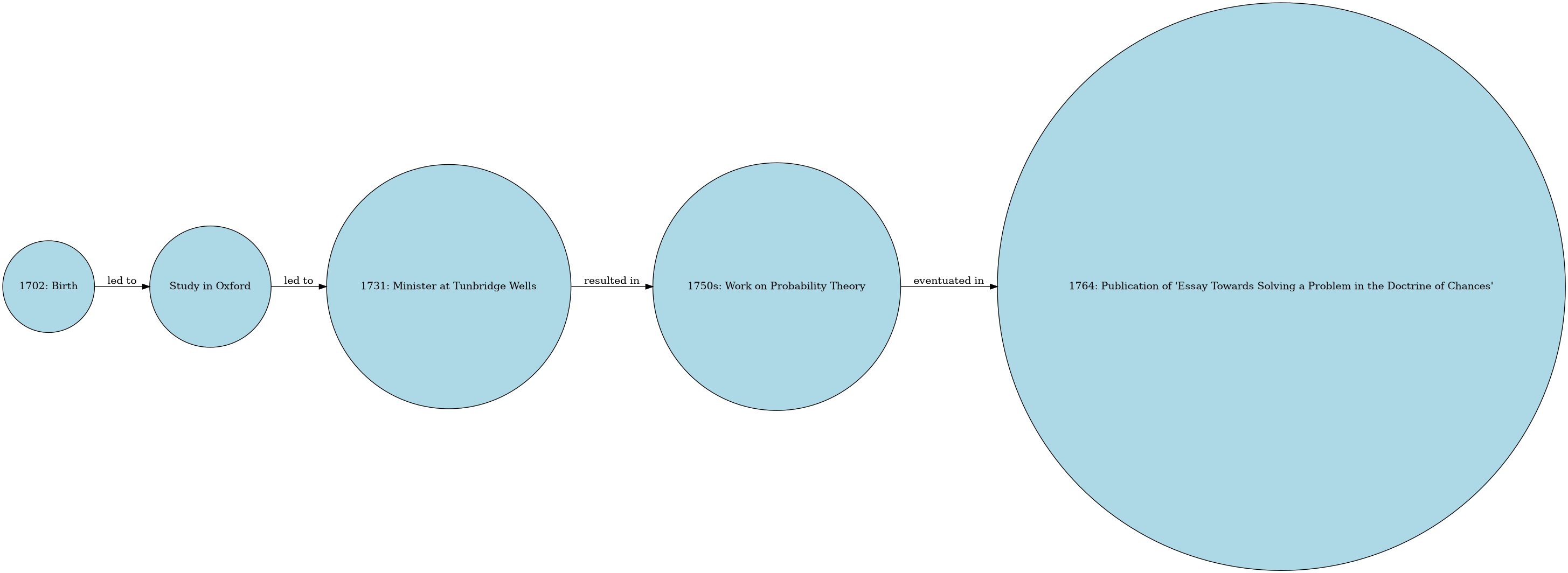
- 1702: Thomas Bayes is born in London, England.
- 1731: Bayes becomes a minister at Tunbridge Wells, Kent.
- 1750s: Bayes begins working on his probability theory.
- 1764: Bayes publishes “Essay Towards Solving a Problem in the Doctrine of Chances” posthumously.
- Late 18th century: Pierre-Simon Laplace and other mathematicians build upon Bayes’ work.
Key Terms and Concepts
Probability Theory: The branch of mathematics that deals with the study of chance events and their likelihood. Probability theory provides a framework for understanding and quantifying uncertainty.
Bayesian Probability: A method of updating probabilities based on new evidence or data, which allows for more accurate predictions and informed decisions.
Expected Utility: A concept developed by Bayes, where the expected value of an event is calculated as the product of its probability and the payoff received in case of that event.
Conditional Probability: The probability of an event occurring given that another event has occurred. Conditional probability is a fundamental concept in Bayesian probability theory.
Independent Events: Events that do not affect each other’s likelihood or occurrence.
Random Variables: Quantities whose values are determined by chance, such as the number of heads obtained when flipping a coin.
Key Figures and Groups
- Thomas Bayes: A British mathematician and Presbyterian minister who developed Bayesian probability theory.
- Isaac Newton: An English physicist and mathematician who laid the foundations for classical mechanics.
- Gottfried Wilhelm Leibniz: A German philosopher and mathematician who developed calculus independently of Isaac Newton.
Mechanisms and Processes
- Problem formulation: Bayes identifies a problem in probability theory, where he seeks to calculate the probability that an event lies between two given degrees of probability.
- Mathematical development: Bayes develops his solution using mathematical tools such as algebra and calculus.
- Publication: Bayes publishes “Essay Towards Solving a Problem in the Doctrine of Chances” posthumously in 1764.
Deep Background
The concept of probability dates back to ancient civilizations, where people used various methods to predict outcomes, such as astrology and divination. In the 17th century, mathematicians like Blaise Pascal and Pierre de Fermat developed the foundations for probability theory. However, it wasn’t until Bayes’ work that the field began to take shape.
Explanation and Importance
Bayesian probability revolutionized statistical inference by providing a method for updating probabilities based on new evidence or data. This approach has far-reaching implications in fields such as statistics, economics, finance, and medicine. The concept of expected utility allows decision-makers to quantify the potential outcomes of their choices, making more informed decisions possible.
Comparative Insight
In comparison to other mathematical frameworks, Bayesian probability stands out for its ability to incorporate new information and adapt to changing circumstances. This flexibility has led to widespread adoption in various fields.
Extended Analysis
1. The Role of Bayes’ Theorem
Bayes’ theorem is a fundamental concept in Bayesian probability theory, which allows for the updating of probabilities based on new evidence or data. This theorem provides a mathematical framework for understanding and quantifying uncertainty.
2. Applications in Statistics
Bayesian statistics has numerous applications in fields such as medicine, finance, and engineering. By incorporating prior knowledge and new data, Bayesian methods provide more accurate predictions and informed decisions.
3. Criticisms and Limitations
While Bayesian probability offers many benefits, it also faces criticisms regarding its assumptions and limitations. Some argue that the method relies too heavily on prior distributions, which can lead to overfitting or underfitting.
Open Thinking Questions
- How does Bayesian probability compare to other statistical frameworks?
- What are some potential applications of Bayesian statistics in real-world scenarios?
- Can you identify any limitations or criticisms of Bayesian probability theory?
Conclusion Bayesian probability is a foundational concept that has shaped the field of mathematics and its applications. Developed by Thomas Bayes, this innovative approach to probability theory provides a framework for understanding and quantifying uncertainty. As our world becomes increasingly complex, the need for more sophisticated mathematical tools continues to grow.