A Conditional Freedom: The Venetian Jewish Community in the Sixteenth Century
A Conditional Freedom: The Venetian Jewish Community in the Sixteenth Century
Overview The Venetian Jewish community experienced a precarious existence throughout the sixteenth century. Despite facing numerous challenges and restrictions, they managed to secure certain privileges and protections through negotiation with the Venetian government. This period saw the development of a complex relationship between the Jews and their ruling authorities, marked by both cooperation and tension.
Context In the sixteenth century, Venice was a major trading power in the Mediterranean, with extensive connections to the Ottoman Empire. The city’s Jewish population, which numbered around 1,000 individuals, played an important role in its economy as merchants and traders. However, their position was constantly subject to change due to shifting political circumstances.
Timeline
- 1537: War breaks out between Venice and the Ottoman Empire; Venetian Senate orders sequestration of property of ‘Turks, Jews, and other Turkish subjects’.
- 1570-1573: Another war with the Ottomans leads to the arrest of all Jews and seizure of their property.
- 1589: Daniel Rodriga negotiates a charter granting Jews Venetian subject status, permitting Levant trade, and allowing religious practice.
- 1623: Leon Voltera sues Antonio dalla Donna for debt; Voltera is successful in court.
- 1636-7: Scandal involving bribery of judges, with some Jewish involvement, raises threat of expulsion.
Key Terms and Concepts
- Conditional Freedom: The status of the Venetian Jews, subject to change based on political circumstances.
- Levant Trade: A valuable privilege granted to Jews in 1589, allowing them to engage in trade with the Ottoman Empire.
- Subject Status: The legal status of Jews as citizens of Venice, granting them certain rights and protections.
- Guilds: Organizations that regulated various trades and professions; Jews were not allowed to join guilds.
Key Figures and Groups
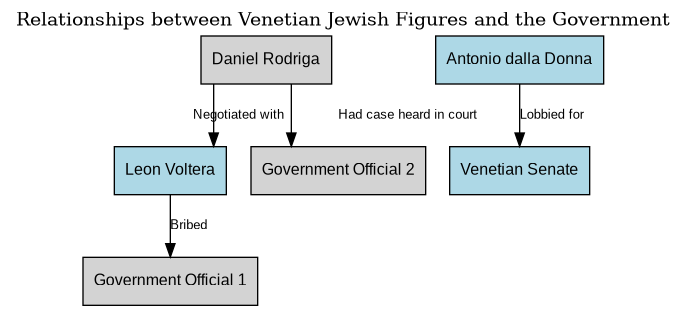
- Daniel Rodriga: A Jewish merchant of Spanish origin who successfully negotiated the 1589 charter for the Venetian Jews.
- Leon Voltera: A Venetian Jew who sued Antonio dalla Donna in 1623 and won his case.
- Venetian Senate: The ruling body of Venice, responsible for making laws and governing the city-state.
Mechanisms and Processes
The complex relationship between the Venetian Jews and their rulers can be broken down into several key steps:
- Negotiation: Daniel Rodriga’s successful negotiation with the Venetian government in 1589 led to the granting of subject status, Levant trade privileges, and religious freedom.
- Implementation: The charter negotiated by Rodriga was implemented, allowing Jews to engage in the Levant trade and practice their religion openly.
- Tension: Despite these gains, tensions between the Jews and their rulers persisted, as seen in the 1636-7 scandal involving bribery of judges.
Deep Background
The Venetian Jewish community had a long history of interaction with the ruling authorities. In the thirteenth century, they were granted privileges by the Doge Enrico Dandolo, including permission to engage in trade and settle in Venice. However, their position remained precarious throughout the fourteenth and fifteenth centuries, subject to various expulsions and restrictions.
Explanation and Importance
The Venetian Jewish community’s conditional freedom highlights the complex relationships between Jews and Christian rulers during this period. Despite facing numerous challenges, they managed to secure certain privileges and protections through negotiation. The 1589 charter represented a significant gain for the community, allowing them to engage in the Levant trade and practice their religion openly.
However, tensions persisted, as seen in the 1636-7 scandal involving bribery of judges. This highlights the ongoing power dynamics between the Jews and their rulers, with the community constantly seeking to secure its position within the city-state.
Comparative Insight
The Venetian Jewish community’s experience can be compared to that of other Jewish communities in Europe during this period. The Spanish Inquisition, for example, led to widespread persecution and expulsion of Jews from Spain and Portugal. In contrast, Venice offered a more tolerant environment, albeit with certain restrictions.
Extended Analysis
- The Role of Negotiation: Daniel Rodriga’s success in negotiating the 1589 charter highlights the importance of negotiation in securing privileges for the Venetian Jewish community.
- The Impact of Conditional Freedom: The conditional nature of the Jews’ freedom had significant implications for their daily lives, as they were subject to change based on political circumstances.
- Tensions and Power Dynamics: The ongoing tensions between the Jews and their rulers highlight the complex power dynamics at play in this period.
Open Thinking Questions
• What role did negotiation play in securing privileges for the Venetian Jewish community? • How did the conditional nature of their freedom impact daily life for the Jewish population? • What can be learned from comparing the experiences of different Jewish communities during this period?
Conclusion The Venetian Jewish community’s experience throughout the sixteenth century was marked by both cooperation and tension with their ruling authorities. Despite facing numerous challenges, they managed to secure certain privileges and protections through negotiation. The 1589 charter represented a significant gain for the community, allowing them to engage in the Levant trade and practice their religion openly.